Last week, the perfect opportunity landed in my inbox. It was everything I wanted in a new role:
I was seriously considering it.
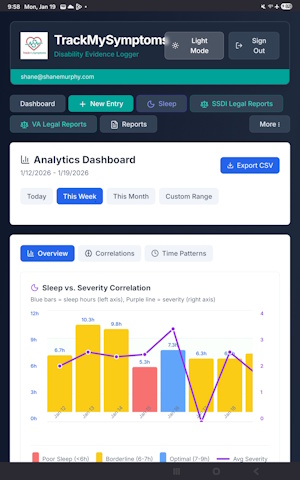
Then I saw what TrackMySymptoms had documented about that same week:
The disability claims process doesn't care about your suffering.
It cares about documentation.
"I experienced severe vertigo on 12 of 30 days, requiring immediate cessation of activity for an average of 3.2 hours per episode, resulting in 38.4 lost functional hours that month."
That's the language bureaucrats understand.
Without documentation, you're fighting an upside-down battle:
Your memory isn't evidence. Your notes aren't organized.
Your spouse can't testify to patterns they can't see.
TrackMySymptoms turns chaos into credibility.
Log symptoms as they occur—or when you remember them. Mobile-friendly, takes 60 seconds. No medical jargon required.
Not "I had a headache."
Your lived experience becomes documented evidence.
Not a wellness app. Not corporate healthcare tech. Not another Silicon Valley "solution" built by people who've never filed a disability claim.
30+ years living with MS. I've navigated every bureaucratic nightmare you're facing.
Designed specifically for disability claims, not generic health tracking.
References Blue Book criteria and VA rating schedules in generated reports.
Your data is yours. Never sold. No insurance partnerships. No data mining.
I built this because I needed it. Then I realized thousands of others were fighting the same battles with notebooks, spreadsheets, and failing memory.
Every feature exists because it solved a real problem in my own disability journey.
Proving "inability to engage in substantial gainful activity" requires patterns, not anecdotes.
Increase ratings require documented frequency, severity, and functional impact.
Judges want timelines, consistency, and credible records.
MS, fibromyalgia, chronic fatigue, migraine, POTS, lupus, Lyme—anything where "it depends on the day."
Walking in with six months of documented patterns changes the conversation.
Give them a tool that captures what they can't see or remember.
"Bad day today. Really tired. Couldn't do much."
"Jan 14, 2026, 10:55 AM – Severe vertigo and ataxia. Unable to stand safely. Severe pain in both eyes. Moderate pain/pressure on both sides of head. Slept much longer than usual last night. Not sure if still recovering from travel or something else developing. Functional capacity: 56% (5.0 hours)."
The difference? One is a complaint. The other is evidence.
That's a disability case. Not a complaint.
We're not venture-backed. We don't answer to investors. We answer to people who need this tool to survive bureaucratic systems designed to deny them.
If you're between claims, waiting for benefits, or financially struggling—email me. We'll work something out. This tool exists to help people, not gatekeep them.
No credit card required for 14-day trial
You can. I did for years. But notebooks don't generate PDF reports, calculate functional capacity percentages, or filter by date ranges. And good luck reading my handwriting after 30 years of MS.
Extremely. Generate Clinical Narratives for your doctors, SSDI/Legal Briefs for attorneys and judges, or detailed summaries with severity breakdowns, symptom clusters, and functional capacity analysis. Filter by date range, symptom type, or severity level. Export to PDF and attach directly to your claim. These aren't generic health summaries—they're built specifically for disability documentation.
You can add entries retroactively. The app timestamps when you CREATE the entry, not when the symptom occurred. Be honest about dates—judges and doctors respect accuracy.
Yes. Encrypted storage, industry-standard security practices. Your data is never sold, analyzed for marketing, or shared without your explicit consent.
No tool can guarantee that. But judges, attorneys, and doctors repeatedly tell claimants: "If only you had better documentation." This gives you that documentation.
That's exactly who this is for. Simple tracking for simple conditions doesn't need an app. TrackMySymptoms handles the complexity—multiple symptoms, overlapping episodes, unpredictable patterns.
For 30 years, I've sat across from doctors, claims examiners, and judges trying to explain what my body does to me.
"When did it start?"
"How often does it happen?"
"Can you work through it?"
Without documentation, I was guessing. Underselling. Hoping they'd believe me.
TrackMySymptoms changed that. It can change it for you too.
LEARN MORE →No credit card required • 14-day trial • Cancel anytime